Fate line palmistry: the line for direction, career, and how chosen your path feels
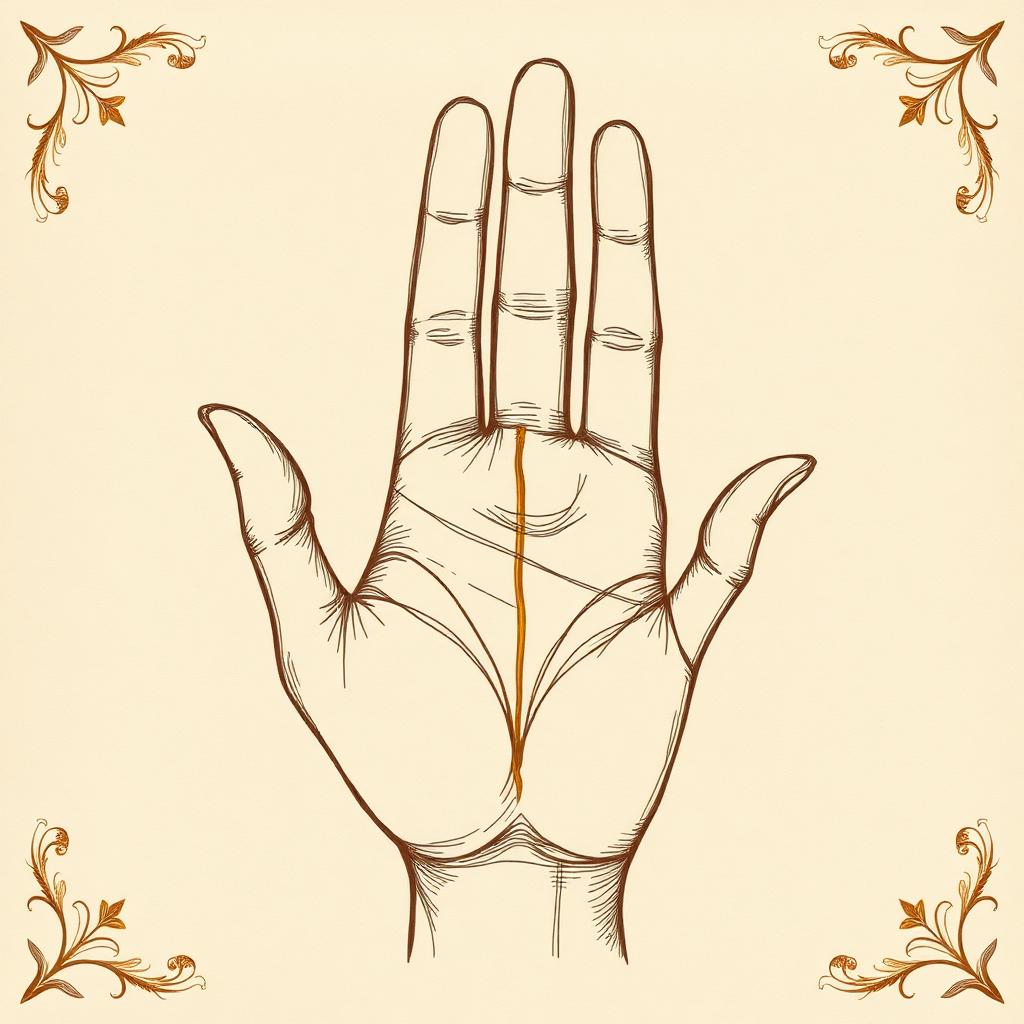
The fate line runs vertically up the middle of your palm toward the base of the middle finger. In palmistry it reads as your sense of direction: career, calling, and how much of your life feels chosen versus handed to you. Some people have a deep single fate line. Many have a broken one. A lot of people have no fate line at all. None of the three is a problem.
Where the fate line is
Open your dominant hand flat under warm light. Most horizontal lines belong to heart, head, and life. The fate line is the vertical one that runs up the middle of the palm, aiming for the base of the middle finger. It can start near the wrist, higher up in the palm, or from the life line itself. Every starting point has its own reading.
Before you go further, a naming note. The fate line, the destiny line, the fortune line, and the luck line are all the same line. Different traditions kept different names. If a source treats them as separate lines, that source is wrong. There is one line, and this is the article for it.
What the fate line actually reads
The fate line is the line palmistry uses for direction. Career is the obvious one, but it is broader than a job: it is the sense of being pointed somewhere. A clear, deep fate line reads as a person with a strong internal compass. You know what your work is even when you do not know how to get there. A faint fate line reads as more improvisational, guided by opportunities rather than by a north star. Both work.
The fate line is the least stable of the major lines. Head, heart, and life change slowly. The fate line rewrites itself. A serious career change in your thirties can produce a new segment that was not there in your twenties. Photograph your palm every couple of years if you want to watch it move.
What no fate line means
Somewhere between one in five and one in three people have no visible fate line. Old books read this as a sign of a scattered or unlucky life. That is nonsense. In practice, a missing fate line reads as a life that is not organized around one overriding calling. You choose the next thing based on where you are, not on a plan you set at twenty. You change directions without a big crisis. You often make a living in several different ways over time.
Plenty of successful, grounded people have no fate line. Freelancers, generalists, parents whose main work is the family, people who moved country and started over. The line is not a scorecard.
Where the fate line starts
The starting point of the fate line is more informative than its length.
From the wrist
A fate line that starts low, close to the wrist, reads as a strong sense of direction early in life. You knew what you were going to do, or at least what world you belonged in, before most of your friends did.
From the life line
A fate line that begins from the life line rather than the wrist reads as a path shaped by family and background. Not held back by it, shaped by it. Family business, a parent's field, a culture that pointed you somewhere. The line usually separates from the life line as your own decisions take over.
From the middle of the palm
A fate line that only appears higher up on the palm reads as a late-arriving direction. Your first decade or two of adult work did not feel like the real thing. Somewhere in your thirties or forties the real path showed up, and the line started with it.
From the mount of Luna
A fate line starting from the outer edge of the palm, on the pad opposite the thumb, reads as a life directed by other people as much as by you. Public-facing careers, work that depends on an audience or a client base, work where luck and timing matter more than they should.
Breaks, restarts, and doubles
Breaks
A clean break in the fate line reads as a career change. If the new segment picks up right next to the old one, the change was chosen and the transition was quick. If there is a gap, there was a fallow period first. If the second segment is deeper than the first, the new chapter is a better fit than the one you left.
Restarts
Some fate lines look like two or three overlapping segments, each one starting a little to the side of the last. Palmistry reads this as a series of reinventions. Common on people who have retrained, switched industries, or built their identity around several different bodies of work over time.
Double fate line
Two fate lines running in parallel reads as running two paths at once. A job plus a serious creative practice. Two businesses. A career plus a caretaking role that is doing as much work as any job. The second line is not a distraction; it is a real load-bearing part of the reading.
What the fate line does not tell you
Palmistry has a long habit of overreading the fate line, so let us be blunt about the limits. The line does not predict how much money you will make. It does not name your job title. It does not promise fame if you have a clean line or failure if you do not. When you see the fate line paired with the money line, the sun line, or the career line, that combination can talk about financial focus and recognition. On its own, the fate line reads as direction, not outcome.
How the fate line fits with the other lines
The fate line reads best in context. A deep fate line above a straight head line reads as someone with a plan and the discipline to execute it. A deep fate line above a wavy head line reads as someone with a plan they keep improvising against. A missing fate line paired with a strong heart line often belongs to people whose life is organized around relationships rather than work, and that is fine.
If you are still learning the majors, the full palm reading guide walks through them together. If you would rather skip the DIY, get an online palm reading and let a reader do the interpretation for you.
Frequently asked questions
- Where is the fate line on the palm?
- The fate line runs vertically up the middle of the palm, usually from somewhere near the wrist toward the base of the middle finger. It is the only major line that runs top to bottom instead of side to side. Not everyone has one.
- What does it mean if I do not have a fate line?
- It is more common than most people think. Missing the fate line reads as a life that is not shaped by one overriding path. You choose your direction as you go, you change tracks without much friction, and you rarely feel called to a single vocation. That is a description, not a warning.
- Is the fate line the same as the destiny line or fortune line?
- Yes. Fate line, destiny line, fortune line, and luck line are four names for the same line. Different palmistry traditions favor different names, but the line and its reading are identical.
- What does a broken fate line mean?
- A broken fate line usually maps to a career restart. A break followed by a fresh segment starting a little to the side reads as a genuine change of path, often chosen. If the second segment is deeper than the first, the new chapter is going better than the old one.
- What does a double fate line mean?
- Two fate lines running side by side, or a shorter parallel fate line joining the main one partway up, reads as running two paths at once. Career plus a serious side project, two businesses, a job plus a strong second calling. It is not a burden reading; it is a range reading.
- Which hand shows the real fate line?
- Read your dominant hand for the direction you are actually taking. The non-dominant hand shows the path you were pointed at when you started. When the two look very different, the gap is where the interesting conversation lives.
Keep reading
- Money Line in Palmistry
Wealth, career, and the marks people call the money line.
- Heart Line Palmistry
How you love, how you attach, how you fight, all on one line.
- Life Line Palmistry: Meaning, Length, Breaks & Myths
What your life line actually says (and what it does not).
- Palm Reading: The Complete Guide to Palmistry
The full palmistry guide: every line, every mount, every hand shape in one place.