Palm reading: the complete guide to palmistry
Palm reading looks at the lines, mounts, and shape of your hand and reads them as a snapshot of who you are and what you are working with. It is not a prediction engine. It is a mirror. This guide walks through everything on the palm, in plain language, with links out to full write-ups for each line and sign.
What palmistry actually is
Palmistry, sometimes called chiromancy, is the reading of a person's hand: the lines, the raised areas known as mounts, and the shape of the fingers and palm. It shows up independently in Indian, Chinese, Greek, and Roma traditions, which is a hint that people have been staring at each other's hands for a very long time.
Treated as prediction, palmistry does not hold up. Your hand does not contain the year you will marry or the size of your next paycheck. Treated as a self-reflection tool it does hold up. The hand catches vitality, temperament, stress, and the shape of the chapter you are in right now, and it does it well enough that people keep coming back to it after two thousand years.
A reader's ethic before we start. No death predictions from the life line. No medical diagnoses from the health line. No income promises from the money line. Anyone who tries any of the three is working from a script.
The palm at a glance
Open your dominant hand flat under decent light. You are looking at four zones: the fingers, the palm itself, the mounts (the fleshy pads under each finger and around the edges), and the wrist.
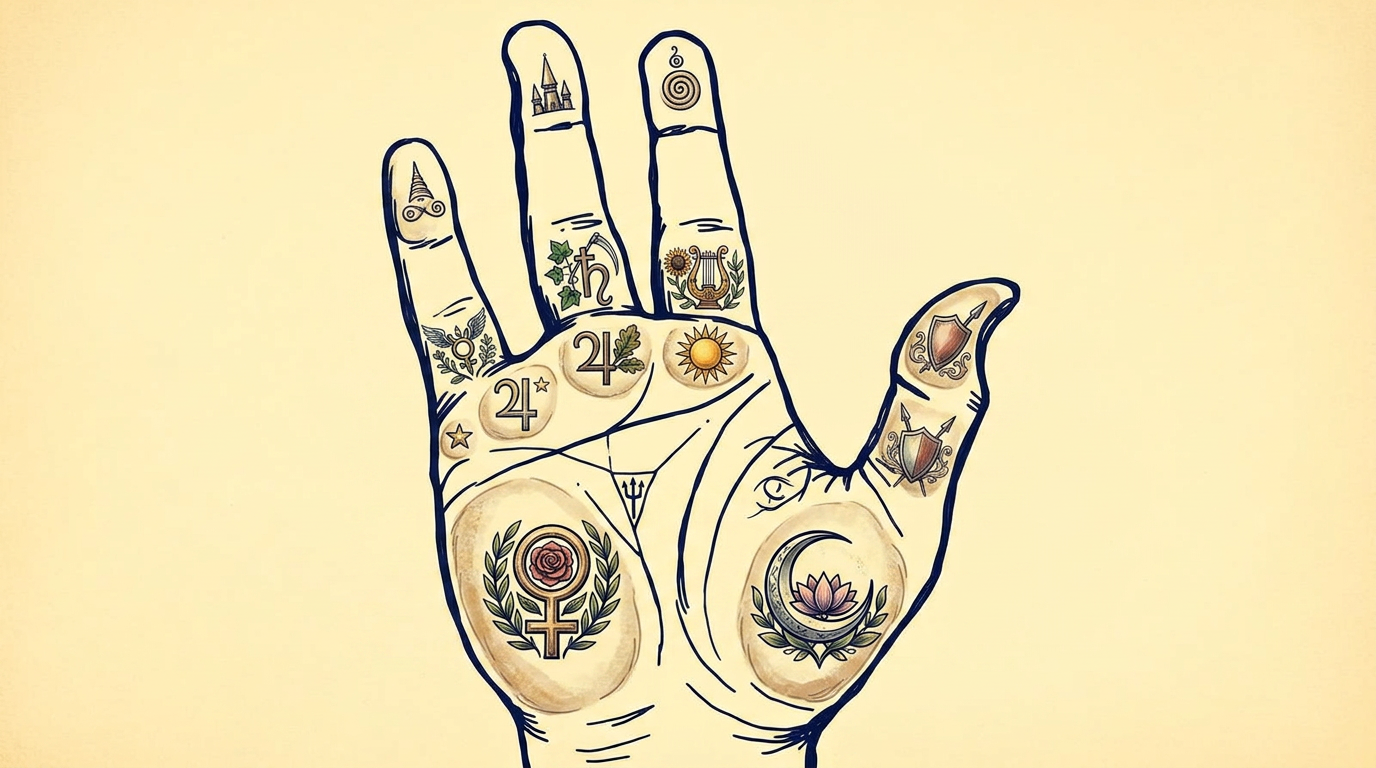
Three lines are almost always visible: the heart line under the fingers, the head line across the middle, and the life line curving around the base of the thumb. A fourth, the fate line, runs vertically toward the middle finger on most but not all people. Those four are the majors. Everything else is a minor line, a sign, or a mount.
The four major palm lines
Heart line
The heart line runs across the top of the palm, closest to the fingers. It handles how you love, how you attach, and how you argue. A straight heart line reads as controlled, steady love. A curved line that sweeps up toward the index finger reads as expressive, out-loud love. Chains, breaks, and forks each have their own reading. Full heart line write-up.
Head line
The head line runs horizontally across the middle of the palm, usually just below the heart line. It handles how you think: fast or careful, practical or associative, decisive or wandering. Long head lines belong to people who reason things out. Short head lines belong to people who trust their gut and move.
Life line
The life line arcs around the base of the thumb. It reads as vitality and groundedness, not lifespan. A short life line does not mean a short life. A wide arc into the palm reads as appetite for travel and experience. A tight arc reads as attachment to home base. Full life line write-up.
Fate line
The fate line runs vertically up the middle of the palm toward the middle finger. It handles the sense of direction in your life, mostly career and calling. A single clean fate line reads as one long vocation. A broken fate line with restarts reads as several career chapters, which describes most modern working lives. Full fate line write-up.
Minor lines worth knowing
Once you can find the four majors, these are the smaller lines readers look for next.
Marriage or affection lines
Short horizontal lines on the outside edge of the palm under the pinky. Most people have between one and three. They read as significant relationships, not weddings. One deep line usually points to one big attachment. More on the marriage line.
Sun line (Apollo line)
A short vertical line rising under the ring finger. Also called the success line. It reads as public recognition and creative confidence when it shows up, not guaranteed fame when it does not.
Health line (Mercury line)
A faint vertical line rising toward the pinky. Traditionally read as a wellbeing marker. No medical claims here. If it is present, palmists read it as awareness of your own body; if absent, it usually means nothing at all.
Money lines
A cluster of small marks on the mount below the pinky that some readers call money marks, plus faint upward lines on the fate line. These read as periods of financial focus. They do not promise a number. More on the money line.
The mounts of the hand
The mounts are the raised fleshy areas of the palm. Each is named for a classical planet and each colors the reading around it. A prominent mount adds emphasis; a flat mount reads as neutral, not weakness.
- Mount of Venus, the big pad at the base of the thumb, reads as warmth, sensuality, and appetite for physical life.
- Mount of Jupiter, under the index finger, reads as ambition, leadership, and belief in yourself.
- Mount of Saturn, under the middle finger, reads as discipline, patience, and the tendency to take life seriously.
- Mount of Apollo (Sun), under the ring finger, reads as creativity, style, and public warmth.
- Mount of Mercury, under the pinky, reads as communication, business instinct, and quick thinking.
- Mount of Luna, the pad on the outer edge of the palm across from the thumb, reads as imagination, intuition, and pull toward travel.
- Mount of Mars, the small area between the thumb and index finger, reads as courage, drive, and the willingness to push back.
The four hand shapes
Palmistry sorts hands into four elemental shapes matched to fire, earth, air, and water. The shape reframes everything you read afterward. A curved heart line on a fire hand plays differently from a curved heart line on a water hand.
Fire hand
Long palm, short fingers. Deep, plentiful lines. Reads as high energy, appetite, and a preference for doing over thinking.
Earth hand
Square palm, short fingers. Few, deep lines. Reads as practical, steady, and body-oriented. Reliable and hard to rush.
Air hand
Square palm, long fingers. Many fine lines. Reads as verbal, curious, and mentally quick. Air hands often belong to writers, teachers, and engineers.
Water hand
Long palm, long fingers. Many fine lines, often faint. Reads as sensitive, imaginative, and emotionally attuned. Water hands feel every mood in the room.
Which hand do you read?
Read your dominant hand for the life you are living now and your non-dominant hand for what you were born with. Right-handed people read the right first. Left-handed people read the left. Ignore the old split-by-sex rules. If the two hands look very different, the gap is where the reading gets interesting: it usually means the life you were set up for is not the life you are actually living.
Your first palm reading, step by step
- Set the light. Daylight or a bright warm lamp. Not overhead fluorescent, which flattens the lines.
- Find the four majors. Heart line at the top, head line across the middle, life line around the thumb, fate line up the center if you have one.
- Read the heart line first. Straight or curved? Deep or faint? Where does it end?
- Read the head line next. Long or short? Straight or sloping? Chained or clean?
- Read the life line. Wide arc or tight? Any breaks or a double line beside it?
- Look for the fate line. Present or absent? Single run or restart in the middle?
- Note the hand shape and dominant mount. That one shape and one mount will color everything you just read.
- Write it down. Even a paragraph. Come back to it in six months.
Palm reading for women, men, and everyone else
Almost every meaning on this page holds up regardless of who is holding the hand. Old books used to split the rules by sex, and most modern palmists have stopped. If you want the female-hand read specifically, with the marriage and children questions handled directly, there is a separate write-up in palm reading for women.
Do palm lines change?
Yes. Depth shifts with hydration, workload, and vitality. New fine lines appear during long stress. Breaks can close over years. Photograph your dominant hand today. Photograph it again in two years. The changes will be small, but they are there. That is the whole argument for palmistry as a mirror rather than a prediction: the hand keeps updating.
Get a real palm reading
If you want a written reading done for you rather than the DIY version, book an online palm reading. One clear photo of your hand comes back as a full report by email. No appointment, no theatre, no upsell.
Frequently asked questions
- What is palmistry?
- Palmistry, sometimes called chiromancy, is the practice of reading the lines, mounts, and shape of a person's hand to describe personality patterns and life themes. It is not a lab science. Treated as a self-reflection tool it holds up well; treated as prediction it does not.
- Which hand do you read in palmistry?
- Modern palmistry reads your dominant hand for how you are living now and your non-dominant hand for what you were born with. Old books split the rule by sex; ignore that. If the two hands look very different, the gap is the interesting part of the reading.
- How many major lines are there in palm reading?
- Four. The heart line runs horizontally across the upper palm, the head line runs horizontally across the middle, the life line arcs around the base of the thumb, and the fate line runs vertically toward the middle finger. Not everyone has a visible fate line. The other three are almost universal.
- Is palm reading real?
- Depends what you mean by real. There is no evidence your palm predicts specific future events. There is a long, cross-cultural tradition of using the hand as a mirror for personality, habits, and life chapters. The self-reflection use is the honest one.
- Can palm lines change?
- Yes, more than most people think. Depth shifts with hydration, workload, and general vitality. New fine lines appear during long stress. Breaks can close over years. The hand shows where you are, not where you are locked in.
- How do I get a palm reading online?
- Take one clear photo of your dominant hand in daylight. A written online palm reading uses that photo to read your major lines, mounts, and hand shape, then delivers a full report by email. No appointment, no video call.
The full guide, by section
Every palmistry write-up on the site, grouped so you can jump straight to the piece you need.
Palm lines
- Life Line Palmistry: Meaning, Length, Breaks & Myths
What your life line actually says (and what it does not).
- Heart Line Palmistry
How you love, how you attach, how you fight, all on one line.
- Head Line Palmistry
The line that hints at how you think and where your mind wanders.
- Fate Line Palmistry
The line for direction, career, and how much of it feels chosen.
- Marriage Line Palmistry
Reading the tiny lines below your pinky for relationship timing.
- Broken Heart Line in Palmistry
What a broken heart line means, and why it is less scary than it sounds.
- Sun Line (Apollo Line) in Palmistry
Also called the success or Apollo line. What it really tracks.
- Health Line (Mercury Line) in Palmistry
The mercury line and what palmistry says about wellbeing.
- Money Line in Palmistry
Wealth, career, and the marks people call the money line.
- Career, Business & Education Lines on Your Palm
Work, business, and study lines that show up beyond the fate line.
- Travel Lines in Palmistry
Foreign travel, relocation, and settlement marks on the palm.
Signs and symbols
How to read palms
- How to Read Palms: Palm Reading for Beginners
A step by step walk through a first palm reading, in plain language.
- Which Hand to Read in Palmistry?
Left or right? A short answer for beginners.
- Palmistry Mounts: The 8 Mounts of the Hand & Their Meanings
Venus, Jupiter, Saturn, Apollo, Mercury, Luna, and the two Mars mounts, without the mystical fog.
- Palmistry Fingers & Thumb: What Finger Shapes Reveal
Thumb, index, middle, ring, pinky. What each finger and its shape adds to a reading.
- The 4 Hand Shapes in Palmistry: Fire, Earth, Air & Water Hands
Earth, air, fire, water. The four elemental hand shapes and what each one changes in your reading.
By hand
Traditions and cousins
- Chinese Palm Reading: How It Differs from Western Palmistry
The Chinese tradition, the eight trigrams on the palm, and where it agrees or splits from Western reading.
- Indian & Vedic Palmistry (Hast Rekha): A Complete Introduction
Hast rekha in English: the Indian and Vedic tradition, the mounts as planets, and how it reads a hand.
- Cheiro: The Legendary Palmist & His Palmistry System
The Victorian palmist who read Twain, Wilde, and Edward VII, and the system he left behind.
- Palm Leaf Reading (Nadi Astrology): What It Is & How It Works
Nadi astrology is not palmistry. It is an older Tamil manuscript tradition, and here is how it actually works.
- Foot Reading (Feet Palmistry): Lines & Signs on Your Feet
The cousin of palmistry that reads the sole of the foot instead of the palm.
- Famous Palms: Elon Musk, Bill Gates & Celebrity Palm Readings
What palmistry writers have said about famous hands, from Silicon Valley to Bollywood.