Life line palmistry: what it actually says, and what it does not
The life line is the curved line that wraps around the base of your thumb. In palmistry it tracks vitality, groundedness, and how connected you feel to your own body. It does not predict when you will die. A short life line does not mean a short life, a break is not a warning, and the line changes across years.
Where the life line is on your palm
Open your dominant hand flat. Look at the arc that starts between your thumb and index finger and curves down around the fleshy pad at the base of the thumb. That is your life line. Sometimes it stops halfway. Sometimes it runs almost all the way to the wrist. Sometimes it splits into two. All of that is normal.
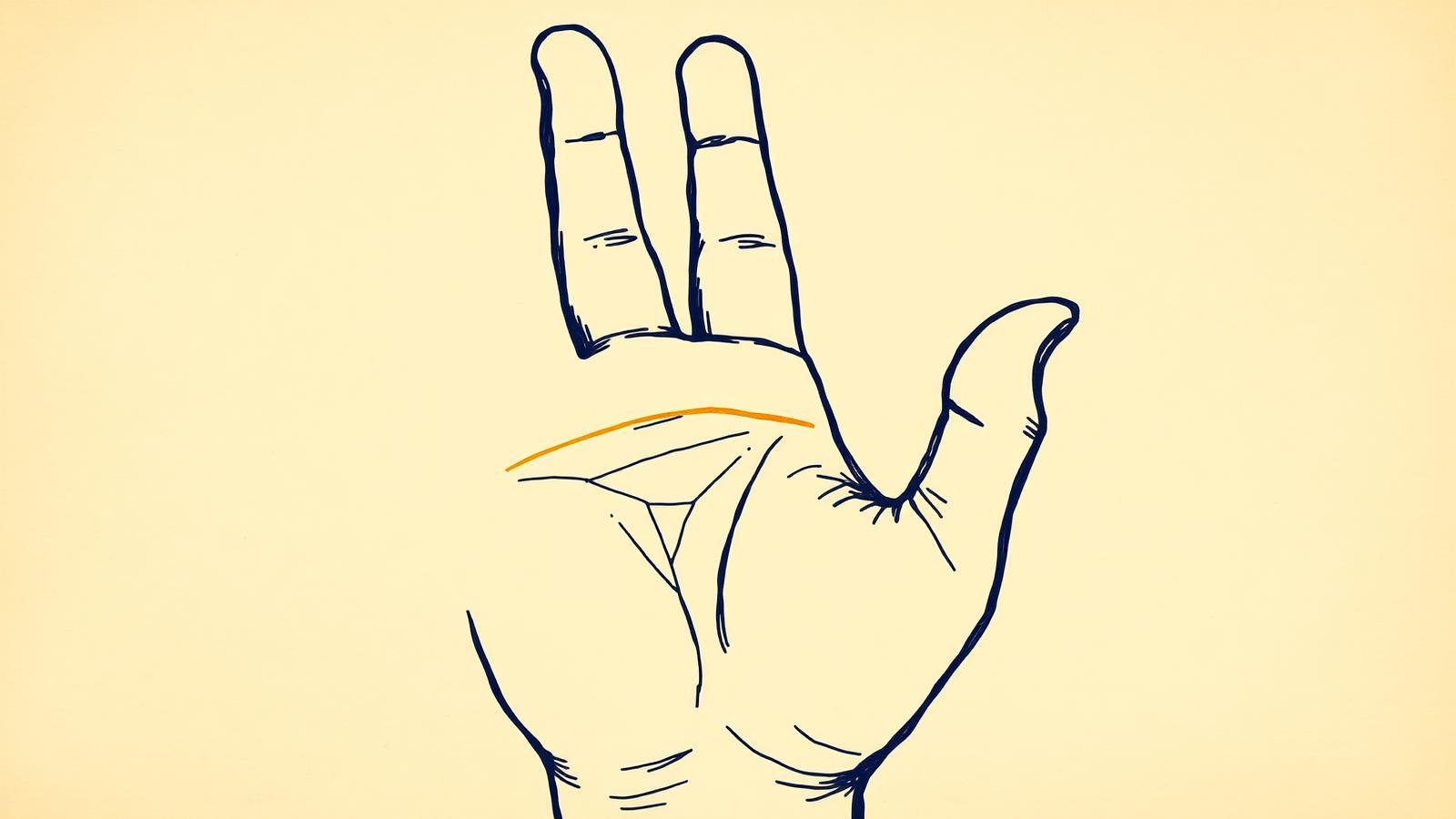
People confuse the life line with two neighbours. The head line runs across the middle of the palm, not around the thumb. The fate line runs vertically toward the middle finger. If you can see three lines and the one that arcs around your thumb is the deepest, you are looking at the life line.
What the life line actually means
Read the life line as a snapshot of your physical baseline. Depth suggests stamina. A deep, clean curve tends to belong to people who feel at home in their bodies and recover quickly. A faint line more often shows up on people who live in their heads, sleep badly, or have been running on fumes for a while. Neither is a verdict. Lines change.
The other thing the life line tracks is groundedness. How wide the arc swings out into the palm matters. A generous arc that pushes out toward the centre of the hand belongs to people who want to be involved, want to travel, want physical experience. A tight arc that hugs the thumb reads as more inward, more careful, more attached to a home base.
The short life line myth
This is the biggest question people bring to a palm reader, so it is worth being blunt about it. A short life line does not mean a short life.
There is no serious tradition in palmistry that reads length as a lifespan timer, and there is no data behind it. It became a story because it makes for a dramatic reading, and because the movies leaned on it. When a modern palmist looks at a short life line, they read it as a person who lives in bursts, or someone whose current chapter is compressed and intense, or someone whose vitality is being pulled into the mind rather than the body. Not a death sentence. If a reader tells you otherwise, walk out.
Long, deep, and clean lines
A long life line that runs almost to the wrist is usually read as a strong physical constitution and a life that unfolds in one long chapter rather than several sharp turns. Depth adds emphasis. A long and deep life line often shows up on people who work with their bodies, athletes, parents of small children, anyone who is physically busy for years at a stretch.
Breaks, chains, islands, and forks
This is the part of the life line that scares people, and it should not. Every mark has a plain reading.
Breaks
A break in the life line usually maps to a change you can name once you look for it. A move to a new country. A breakup that reshaped how you lived. A health event you recovered from. A career switch that felt like starting over. If the line picks up again close by, palmistry reads that as the same life continuing on new terms. If the second segment starts further into the palm, the change was bigger.
Chains
A chained section (little linked loops instead of one clean line) is read as scattered energy. It often corresponds to a stretch of stress, poor sleep, or overload. Chains tend to smooth out when life settles.
Islands
An island is a small oval loop sitting inside the line. Read it as a period of feeling stuck or unwell, often something quiet like burnout or a long recovery. Islands close and the line resumes.
Forks at the end
A fork where the line splits at the wrist is one of the more optimistic marks in traditional palmistry. It is usually read as a life that branches, often into travel, or into a second career you did not plan for.
The double life line (or Mars line)
Some people have a faint second line running parallel to the main life line, closer to the thumb. It is called a sister line, a Mars line, or a double life line. Palmistry treats it as extra reserve. More physical resilience, quicker recovery from illness or exhaustion, or a protective figure or relationship in your life that acts as backup. It shows up more often in people with high stamina and in people who have been through something big and come out standing.
Which hand to read for the life line
Read your dominant hand for the life you are living now and your non-dominant hand for what you were born with. If you are right-handed, your right palm shows the current chapter and your left palm shows the raw material. If the life lines on the two hands look very different, that gap is the interesting part. It usually means the life you were set up for is not the life you are actually living, for better or worse. There is a full write-up on this in which hand to read.
Female and male hands
Some old palmistry books read the life line differently for women and men. Most modern readers do not. Hand size and skin thickness do change how deep and long a line looks, and those track loosely with sex, but the meaning of a mark does not change based on who is holding the hand. A short life line on a woman is not a short life. Nor is it on a man.
Do lines actually change?
Yes, more than people expect. Depth changes with hydration, workload, and general vitality. New tiny lines appear during long stress. Breaks can close over the years. If you photograph your palm now and again in two years, the differences will be small but real. That is the whole premise of palmistry as a self-reflection tool rather than a prediction engine. The hand shows where you are, not where you are locked in.
How the life line fits with the other lines
The life line is one of four majors. It works with the heart line, the head line, and the fate line to give a fuller picture. The life line handles the body. The heart line handles how you love and attach. The head line handles how you think. The fate line handles the sense of direction. A short life line paired with a strong fate line reads very differently from a short life line with no fate line at all.
If you are new to reading palms, start with the four majors before you go looking for anything smaller. The full palmistry guide walks through them in order.
Want a personal read?
If you would rather have someone else look at your hand and tell you what stands out, our online palm reading gives you a written analysis in plain language. No cold-read theatrics, no death predictions.
Frequently asked questions
- Does a short life line mean a short life?
- No. The length of your life line does not predict how long you will live. Palmistry has never had reliable evidence linking line length to lifespan, and modern practitioners read the life line as a marker of energy, groundedness, and how connected you feel to your body, not a countdown.
- Which hand do I read for the life line?
- Read your dominant hand for how you are living now, and your non-dominant hand for what you were born with. Most people are right-handed, so the right palm shows the current chapter and the left shows the raw material. If the two look very different, that difference is the interesting part.
- What does a broken life line mean?
- A break usually points to a change you can name: a move, a breakup, a career pivot, a health episode you recovered from. It is not a warning about death. If the line picks up again nearby, palmistry reads that as the same life continuing on new terms.
- What is a double life line?
- A second faint line running parallel to the main life line, closer to the thumb, is often called a sister line or Mars line. Palmistry treats it as extra support, more physical resilience, or a protective figure in your life. It shows up more often in people with a lot of stamina.
- My life line is faint or barely there. Should I worry?
- No. A faint life line usually means low physical intensity, not danger. People who live in their heads more than their bodies often have thinner life lines. Depth changes over years and is affected by hydration, work, and general vitality.
- What about chains, islands, and forks on the life line?
- Chains are read as scattered energy, often during stress. Islands (a small loop in the line) tend to mark a period of feeling stuck or unwell that passes when the line closes back up. A fork at the end is usually read as a life that branches, often into travel or a second career.
Keep reading
- Palm Reading: The Complete Guide to Palmistry
The full palmistry guide: every line, every mount, every hand shape in one place.
- Broken Heart Line in Palmistry
What a broken heart line means, and why it is less scary than it sounds.
- Marriage Line Palmistry
Reading the tiny lines below your pinky for relationship timing.
- Money Line in Palmistry
Wealth, career, and the marks people call the money line.