Head line palmistry: the line for how you actually think
The head line runs horizontally across the middle of your palm, just under the heart line. In palmistry it reads as how your mind works: straight and focused, curved and imaginative, wavy and quick, or fused with the heart line into what is called a simian line. This is the practical, non-mystical read of all four variants.
Where the head line is
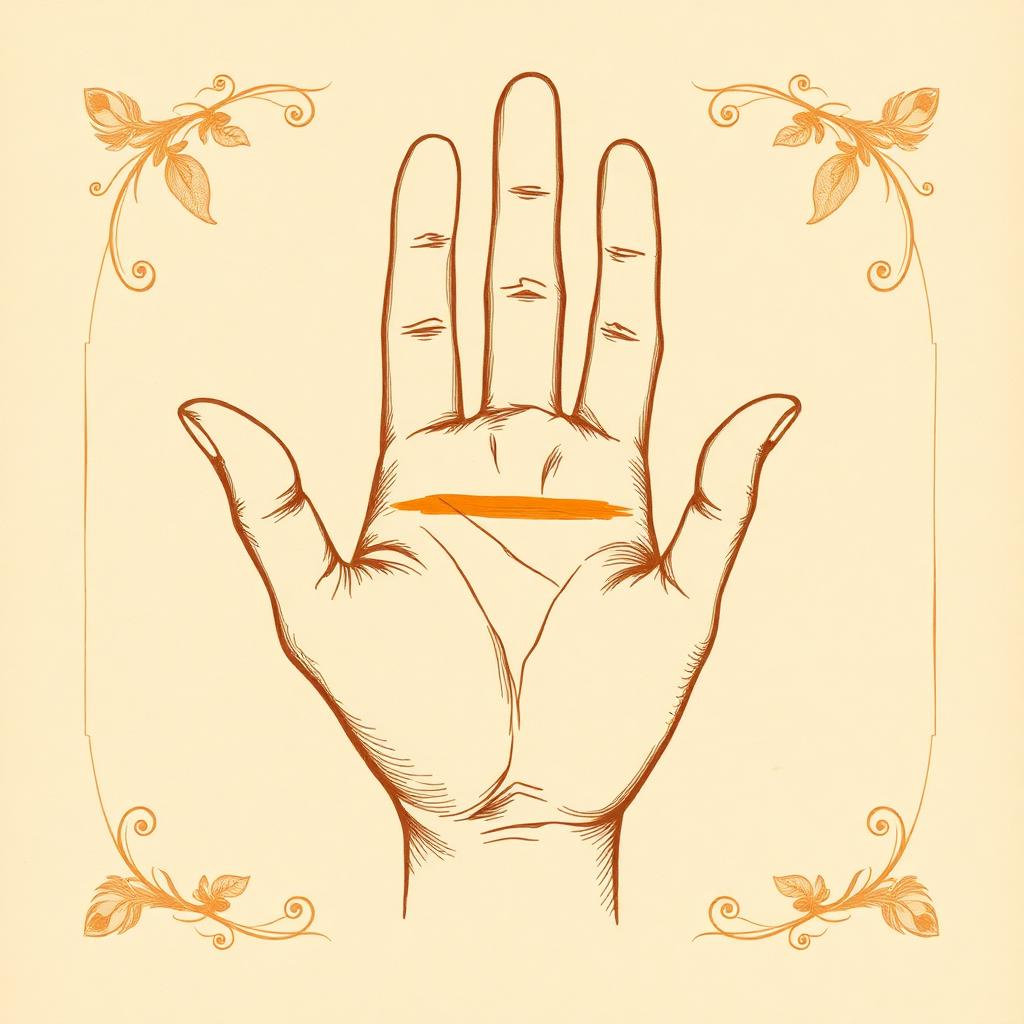
Flatten your dominant hand under warm light. The horizontal line at the top, just under the fingers, is the heart line. The next horizontal line down, running across the middle of the palm, is the head line. It usually begins on the thumb side, somewhere between the thumb and index finger, and travels across the palm toward the outer edge. On most hands it is the longest of the three horizontal lines.
What the head line actually reads
The head line is palmistry's line for cognition. Not intelligence in a school sense, but how your mind moves: how it approaches problems, how it holds detail, how easily it wanders, and how it makes decisions. Deep and clear reads as a mind you can rely on under pressure. Faint and thin reads as a mind that is easier to distract but often more sensitive to nuance.
The shape of the line does more work than its length. A short, deep head line ending at the middle of the palm reads as focused and quick to decide. A long head line that reaches all the way across reads as thorough, slower to conclude, and more comfortable with complexity.
Straight, curved, and wavy
Straight head line
A straight head line running horizontally across the palm reads as practical, linear thinking. You go directly at problems and prefer answers you can test. This is the most common shape and shows up on operators, tradespeople, engineers, and anyone whose work runs on execution rather than speculation.
Curved head line
A head line that curves gently downward toward the outer edge of the palm reads as an imaginative, associative mind. You think in pictures and stories. You often figure things out by writing, drawing, or talking them through, not by staring at them. Common on writers, designers, therapists, and teachers.
Wavy head line
A head line that wanders up and down as it crosses the palm reads as a mind that jumps between ideas. Not scattered as a moral failing; scattered as a working style. People with wavy head lines often do their best work when they have three or four projects running at once and can move between them.
Where the head line starts and ends
The starting point of the head line describes your relationship with independence. A head line that starts joined to the life line and only separates further along reads as someone who took a while to become their own person, usually because family was strong. A head line that starts clearly separated from the life line reads as someone who was independent early, sometimes to a fault.
The endpoint describes where your mind wants to spend its time. A head line ending high, under the ring or little finger, reads as a mind that prefers concrete problems. A head line ending low, sloping down onto the mount of Luna, reads as a mind that prefers imaginative or emotional territory. If your work does not match your ending point, expect friction.
Forks, breaks, and chains
Forked head line
A head line that splits into two at the end is called the writer's fork, and older sources also call it the lawyer's fork. It reads as the ability to hold two views at once. You can argue both sides. You see the other person's frame. Common on writers, mediators, and anyone who has to translate between two worlds for a living.
Broken head line
A clean break in the head line reads as a genuine shift in how you think, usually tied to a real event: an illness, a serious study, a change of profession, or leaving a belief system. If the segments overlap side by side rather than sitting end to end, the shift was a rebuild rather than an interruption.
Chained head line
A head line that looks like a chain of small ovals rather than a single stroke reads as a mind that struggles to hold focus for long. Often maps to periods of anxiety or overwhelm rather than a permanent trait. Compare the head line on your two hands. If the dominant hand is chained but the non-dominant is clean, the pattern is situational, not baseline.
The simian line
The simian line is what palmists call it when the head line and heart line fuse into a single line running straight across the palm. It shows up on roughly one to five percent of people. Because it belongs inside the head line article rather than getting its own, this is the full read of it.
The simian line reads as intensity, not deficiency. Feelings and thinking arrive on the same channel instead of two separate ones. People with a simian line tend to focus hard when they focus, struggle to detach from work they care about, and feel less separation between what they think and what they feel. Old palmistry books read the simian line as a mark of trouble. Modern reading is more useful: it means you experience things all at once, and the trick is designing your life around that instead of fighting it.
A simian line on one hand only is common. A simian line on both hands is rarer and reads as a lifelong pattern rather than a phase.
How the head line pairs with the other lines
The head line reads best in relation to its neighbors. A straight head line paired with a deep fate line reads as someone with both a plan and the discipline to execute it. A curved head line paired with a strong heart line reads as someone whose imagination is fed by their relationships. A wavy head line paired with a clear money line is common on entrepreneurs who make it work despite chasing several bright ideas.
What the head line does not tell you
The head line is not an intelligence score. It does not predict mental illness. It does not diagnose learning differences. A short head line does not mean you are shallow, and a chained one does not mean you are broken. If you want the full context, work through the palm reading guide or send a photo of your hand for an online palm reading and let a reader put the pieces together with you.
Frequently asked questions
- Where is the head line on the palm?
- The head line runs horizontally across the middle of the palm, just below the heart line. It usually starts near the edge of the palm between the thumb and index finger and travels across toward the outer edge. It is the second major line most people see when they look at their palm.
- What does a straight head line mean?
- A straight head line reads as practical, focused thinking. You go in a straight line at problems, prefer facts to theories, and finish what you start. Very common on people who work in operations, trades, engineering, or anything else that rewards clear execution.
- What does a curved head line mean?
- A head line that curves gently downward toward the mount of Luna reads as an imaginative, associative mind. You think in pictures, stories, and connections. Common on writers, designers, therapists, and anyone whose work runs on empathy or creative synthesis.
- What does a wavy head line mean?
- A wavy head line reads as a mind that jumps between ideas. Curious, quick, easily distracted. It is not a concentration problem in itself. It usually belongs to people who work best when they can keep several projects going at once.
- What does a forked head line mean?
- A head line that splits into two prongs at the end is called the writer's fork or lawyer's fork. It reads as the ability to hold two views at once and see both sides. Good for negotiation, writing, teaching, and any work that needs a foot in two worlds.
- What is a simian line?
- A simian line is when the head line and the heart line fuse into one single line running straight across the palm. It shows up on roughly one to five percent of people. It reads as intensity rather than deficiency: feelings and thinking come as one channel instead of two, which can make focus fierce and separation from work hard.
Keep reading
- Heart Line Palmistry
How you love, how you attach, how you fight, all on one line.
- Fate Line Palmistry
The line for direction, career, and how much of it feels chosen.
- Life Line Palmistry: Meaning, Length, Breaks & Myths
What your life line actually says (and what it does not).
- Palm Reading: The Complete Guide to Palmistry
The full palmistry guide: every line, every mount, every hand shape in one place.