Indian and Vedic palmistry (hast rekha) in plain English
Indian palmistry, hast rekha shastra, is the South Asian tradition of reading the hand. It is older than Western palmistry, comes out of the same body of thought as Vedic astrology, and reads the palm alongside the mounts, the fingers, the nails, and often the birth chart as a whole system.
Where the tradition comes from
Indian palmistry sits inside a family of readings called samudrik shastra, the study of the body as a signifier. That family includes face reading, foot reading, and reading of birthmarks and moles. Hast rekha shastra is the branch that reads the hand. It has been documented in Sanskrit texts for centuries and is still practiced today, especially in temple towns and by traditional pandits.
The tradition treats the hand as one instrument in a larger set. A proper reading often includes the birth chart, the numerology of the person's name, and sometimes their handwriting. Palmistry alone is treated as a partial reading.
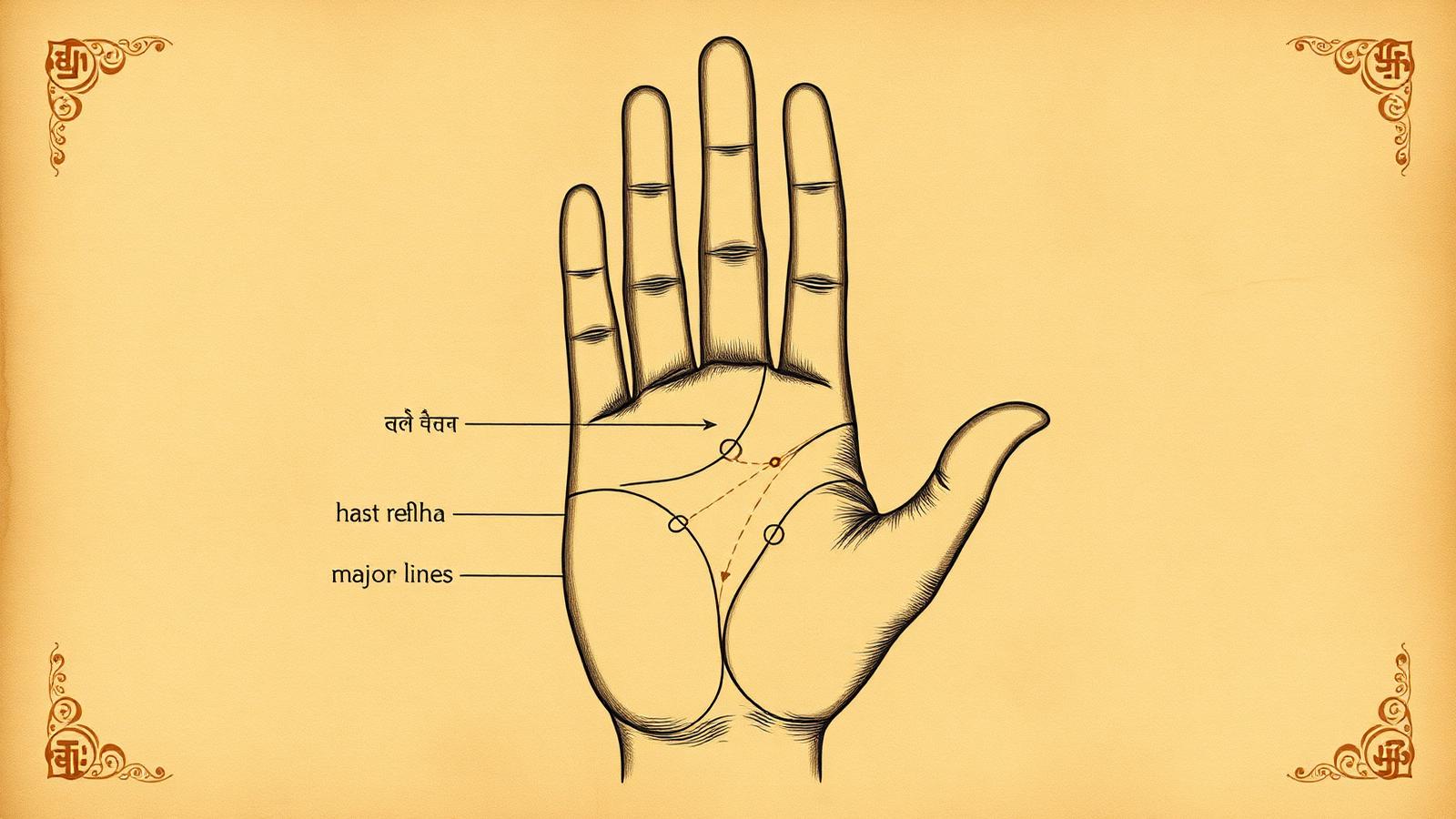
The map: mounts, lines, and fingers
Indian palmistry uses the same seven planetary mounts as Western palmistry. The names are the Sanskrit planets:
- Guru (Jupiter), under the index finger. Leadership, faith, teaching.
- Shani (Saturn), under the middle finger. Discipline, career, seriousness.
- Surya (Sun, Apollo), under the ring finger. Recognition, creative shine.
- Budh (Mercury), under the pinky. Communication, quickness, commerce.
- Shukra (Venus), the fleshy base of the thumb. Love, family, physical warmth.
- Chandra (Moon, Luna), on the outer edge of the palm. Intuition, imagination, travel.
- Mangal (Mars), split into two mounts on either side of the palm. Courage, endurance, temper.
The lines are the same too: heart, head, life, fate. Indian tradition adds heavier attention to the sun line, the health line, the marriage lines, and the vertical lines rising from the wrist called the bracelets or rasettes, which the tradition uses to estimate long-term luck.
What Indian palmistry reads differently
Three real differences.
Fingers and nails carry more weight
Indian palmistry gives finger shape, joint flexibility, and nail shape almost as much attention as the lines. A crooked pinky reads as commercial cunning. A perfectly straight middle finger reads as excessive seriousness. Western palmistry acknowledges these but weights them less.
Timing marks are common
Traditional Indian readings often give age estimates for events: the year of marriage, the year of a career shift, the year of foreign travel. These come from segmenting the fate line, the marriage line, and the travel lines into age ranges. Take them as tendencies, not calendar dates.
The hand is read with the birth chart
Traditional readers rarely read a hand in isolation. They read it against the birth chart, and disagreements between the two are treated as diagnostic: if the chart says one thing and the hand says another, something in the person's life is out of alignment with what they were set up for. This is a very different framing from Western palmistry, which usually reads the hand as the primary text.
Auspicious signs and the mount of the sun
Indian palmistry pays close attention to symbols formed by the lines, especially on the mount of the sun. A star or a triangle on that mount is one of the most sought-after marks in the tradition, read as recognition and steady fortune. The full list of these marks lives in the lucky signs guide, which draws heavily on the Indian tradition.
Which hand to read
The classical rule is left hand for women, right hand for men, with the other hand read for comparison. Modern Indian readers often use the same dominant-hand rule that modern Western readers do. Both are in circulation. If you are getting a reading from a traditional pandit, expect the classical rule.
Hast rekha in Hindi and regional languages
The volume of demand for hast rekha readings in Hindi, Tamil, Telugu, and Urdu is enormous, and native-language content on the topic is the main way most Indian readers learn. If you speak one of those languages, look for teachers and texts in that language. Translation loses a lot in this tradition because the vocabulary is anchored in Sanskrit.
Where this fits with everything else
Indian palmistry, Chinese palmistry, and Western palmistry are cousins. They agree on more than they disagree on and each has strengths. The Chinese palm reading article is the sibling to this one for the East Asian tradition. The celebrity palms article covers how Indian and Western readers have interpreted the hands of famous public figures.
For the full palmistry map in one place, the palm reading guide is the hub.
Frequently asked questions
- What is Indian palmistry?
- Indian palmistry, called hast rekha shastra or samudrik shastra, is the South Asian tradition of reading the hand. It is older than Western palmistry, comes out of the same body of thought as Vedic astrology, and reads the palm alongside the mounts, the fingers, the nails, and often the birth chart as a whole system.
- What does hast rekha mean?
- Hast rekha translates roughly as hand lines. Hast is hand, rekha is line. The full name of the tradition, hast rekha shastra, means the science of hand lines. In English we usually just say Indian palmistry or Vedic palmistry.
- Is Indian palmistry the same as Vedic astrology?
- They come from the same tradition and often use the same vocabulary, but they are separate skills. Vedic astrology reads the birth chart based on the position of the planets at the moment of birth. Indian palmistry reads the hand. A traditional Indian reader will often use both together to check what one is saying against the other.
- Is palmistry allowed in Islam?
- This is a live debate in the Muslim community and answers vary by school and scholar. The most common conservative position treats palmistry as forbidden because it approaches fortune-telling. More liberal readings allow it as a character-reading practice, similar to how horoscopes are treated. If it matters to you personally, ask a scholar you trust rather than a website.
- What is the difference between Indian and Western palmistry?
- The map is largely the same. Both traditions read the same major lines and the same seven mounts, and both use the planetary names for the mounts. Indian palmistry names them after the Sanskrit planet names (Guru for Jupiter, Shani for Saturn), gives more weight to the fingers and nails, and often reads the hand alongside the birth chart. Western palmistry tends to read the hand on its own.
Keep reading
- Chinese Palm Reading: How It Differs from Western Palmistry
The Chinese tradition, the eight trigrams on the palm, and where it agrees or splits from Western reading.
- Famous Palms: Elon Musk, Bill Gates & Celebrity Palm Readings
What palmistry writers have said about famous hands, from Silicon Valley to Bollywood.
- Travel Lines in Palmistry
Foreign travel, relocation, and settlement marks on the palm.
- Palm Reading: The Complete Guide to Palmistry
The full palmistry guide: every line, every mount, every hand shape in one place.