Travel lines in palmistry: what those small marks below your pinky mean
A travel line is a small horizontal line on the outer edge of the palm, below the pinky and above the wrist. Palmistry reads it as a journey that changes you: an emigration, a long stay abroad, a move that reshapes the rest of your life. Regular trips do not show up here.
Where the travel line sits on your palm
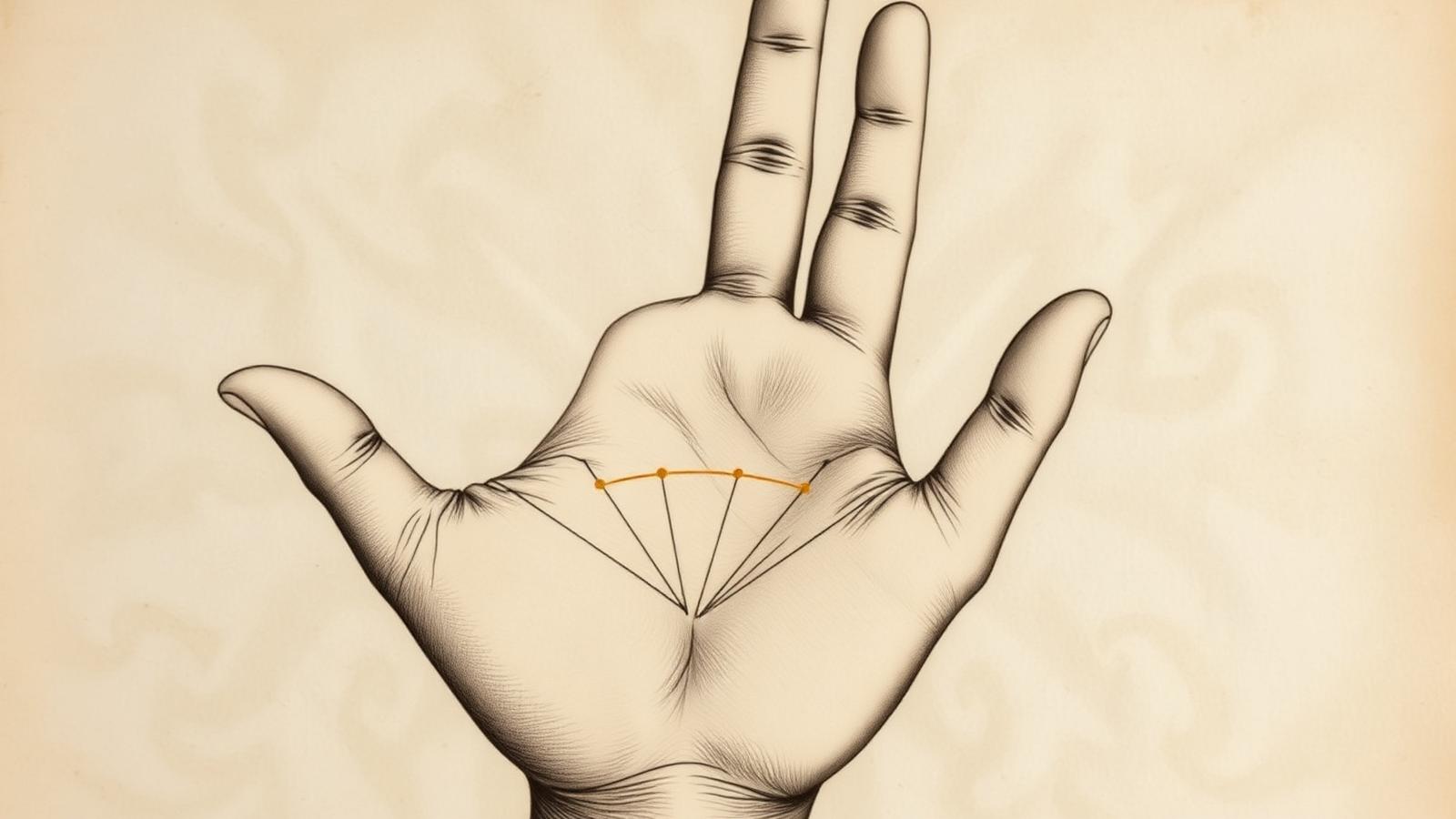
Look at the outer edge of your palm, the karate-chop side. The soft area between your wrist and the base of your pinky is the mount of Luna in palmistry. Any small horizontal lines running from that outer edge into the palm are travel lines. Some are barely a scratch. Others are long and clean.
What each travel line is read as
Palmistry reads travel lines as journeys that actually change you. That is the important word. A holiday, a work trip, a weekend visit does not put a new line on your hand. A year abroad, an emigration, a job that relocates your whole life, those are what the tradition is pointing at.
Long, clean travel lines
A long, uninterrupted line reads as a smooth journey. The move happens, the new place takes, and your life moves on.
Short or shallow lines
Small lines read as shorter chapters abroad. Study terms, contract work, a year that felt formative but did not permanently uproot you.
Broken travel lines
A line that breaks halfway across reads as a journey interrupted. Traditional books call this a return. Modern reading softens it to a plan that did not go the way it was supposed to.
Travel lines that cross the fate line
When a travel line reaches across the palm and touches or crosses the fate line, palmistry reads that as a move that changed your direction in life. The classic case is an emigration that also becomes a new career.
Settlement lines
A travel line that ends in a small square, or that forks cleanly into the fate line, is read as a settlement mark. The tradition says a foreign move takes, the new place becomes home, and there is no going back to the old one. Common on the hands of people who emigrated once and stayed.
Inheritance lines
In the Indian tradition, travel lines are often read together with the inheritance line: a small vertical line rising from the middle of the palm toward the ring finger. It reads as help arriving from outside your own effort, whether family money, an unexpected windfall, or an opportunity that lands in your lap. Palmistry does not promise this. It notes it as a pattern people with the mark often have in common.
The Indian reading of these marks is worth its own article. If you want the full context on where this tradition comes from, the Indian and Vedic palmistry guide covers it in one place.
Travel lines on the female hand
Old palmistry books wrote separate rules for men and women. Modern reading does not. A travel line on a woman's hand reads exactly the same as one on a man's. If you have inherited a family book that says otherwise, treat the gendered rule as a historical curiosity, not a law.
How to actually read your own travel lines
Sit somewhere well lit. Turn your dominant hand slightly toward you so the outer edge catches the light. Count the horizontal lines on the karate-chop side. Note whether any of them cross the fate line, end in a square, or fork into another line. Compare with your non-dominant hand: differences between the two are read the same way as any other line difference, the dominant hand for the life you are actually living, the other for the life you were set up for.
For the wider picture, the palm reading guide walks through every major line in one place. If you would rather have a reader look at your hand and write it up, the online palm reading is the shortest route to that.
Frequently asked questions
- What is a travel line in palmistry?
- A travel line is a small horizontal line on the outer edge of the palm, below the pinky and above the wrist, on the mount of Luna. Palmistry reads it as a journey that changes you, not every trip you take. Weekend visits do not show up here.
- How many travel lines do people have?
- Most palms show one or two clear ones. A hand with four or five reads as someone whose life is shaped by movement, whether that is emigration, long stays abroad, or work that keeps them on the road.
- What is a settlement line?
- A travel line that ends in a small square or a clean fork toward the fate line is read as a settlement mark. The traditional reading is that a foreign move sticks, and the new place becomes home rather than a stop.
- What is an inheritance line?
- The inheritance line is a small vertical line rising toward the ring finger from the middle of the palm, sometimes read alongside travel marks in the Indian tradition. It reads as help arriving from outside your own effort, whether family money, an unexpected windfall, or an opportunity handed to you.
- Do travel lines apply to women's hands the same way?
- Yes. Older palmistry books wrote separate rules for men and women, but modern reading uses the same map. A travel line on a female hand reads the same as one on a male hand.
Keep reading
- Fate Line Palmistry
The line for direction, career, and how much of it feels chosen.
- Indian & Vedic Palmistry (Hast Rekha): A Complete Introduction
Hast rekha in English: the Indian and Vedic tradition, the mounts as planets, and how it reads a hand.
- Palm Reading: The Complete Guide to Palmistry
The full palmistry guide: every line, every mount, every hand shape in one place.
- Online Palm Reading
Get your palm read online in minutes.