Chinese palm reading and how it differs from Western palmistry
Chinese palm reading, shou xiang, is the East Asian tradition of reading the hand. Same hand, different map. It uses the eight trigrams of the I Ching around the palm rather than the Roman planetary mounts, and reads the whole hand as a small model of the person, closer to Chinese medicine than to fortune telling.
Where Chinese palmistry comes from
Chinese palm reading grew out of the same medical and philosophical tradition that produced acupuncture and face reading. The hand is treated as one of several places on the body where the whole system shows up, the way the tongue does in a doctor's diagnosis. That framing is worth holding onto because it changes what the reading is for. In the Chinese tradition, the hand is diagnostic first and predictive second.
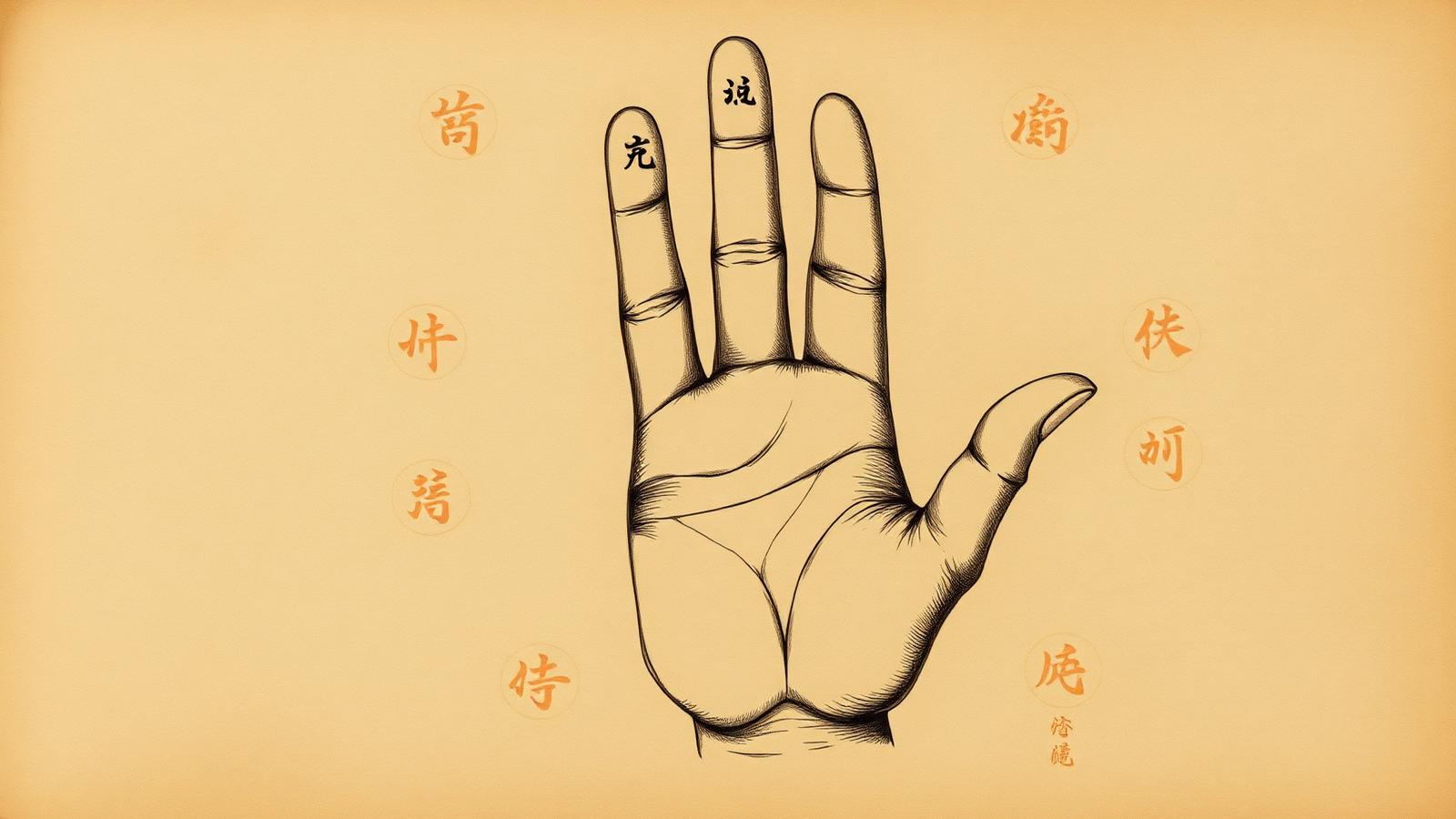
The eight trigrams on the palm
The bagua, the eight trigrams of the I Ching, are laid over the palm as eight small zones. Each trigram is associated with an element, a family member, a direction, and a set of themes. Where Western palmistry names a fleshy pad the mount of Jupiter and reads ambition, Chinese palmistry names the same zone qian and reads leadership, father, heaven.
The vocabulary is different. The reading is often close. A prominent zone under the index finger reads as leadership in both traditions. The Chinese version just gives you more to think about because the trigram brings a family role and an element with it.
How the main lines are read
Chinese palmistry reads the same three main lines as Western palmistry, sometimes under different names. What the Western tradition calls the life line, the head line, and the heart line, the Chinese tradition calls the earthly, human, and heavenly line. The zones and readings overlap on the big things.
The heavenly line (heart line)
Read for emotional life and relationships. A curved line reads as expressive feeling, a straight line as reserved feeling. Very similar to the Western heart line reading.
The human line (head line)
Read for thinking and decision-making. The Chinese tradition weights this line heavily because it is the line of the person themselves, sitting between heaven above and earth below.
The earthly line (life line)
Read for vitality and life circumstances. The Chinese tradition does not read it as literal lifespan any more than modern Western palmistry does.
Which hand to read in Chinese palmistry
The traditional rule is left hand for men, right hand for women, with the other hand read as the counterweight. The idea is that the primary hand shows the destiny you are given, and the other shows what you make of it. Modern Western reading uses dominant hand for the current life and non-dominant for the baseline you were born with.
Neither rule is wrong. They come from different premises. Pick one system per reading and stay consistent. If you want the modern Western answer in full, the which hand to read guide goes into the detail.
Timing in Chinese palmistry
Chinese palm reading uses age-mapping along the main lines the same way Western palmistry does, but the segmentation often runs in the opposite direction along the fate line, and readers use the joints of the fingers as a secondary timing grid. Take dated predictions with the same salt you would take them anywhere else. Palmistry reads tendencies, not calendars.
Chinese and Indian palmistry side by side
Chinese and Indian palmistry evolved separately and both are older than modern Western palmistry. They agree on more than they disagree on. Both treat the hand as a whole system, both use the mounts, and both weight the character of the person over the prediction. If you want the Indian version, the Indian and Vedic palmistry article is the sibling to this one.
For everything under one roof, the palm reading guide is the hub.
Frequently asked questions
- What is Chinese palm reading?
- Chinese palm reading, or shou xiang, is the East Asian tradition of reading the hand. It grew out of Chinese medicine and the I Ching, and it maps the palm using the eight trigrams (bagua) rather than the seven planetary mounts used in Western palmistry. The main lines are read similarly but the framing is different.
- How is Chinese palmistry different from Western palmistry?
- Same hand, different map. Chinese palmistry uses the eight trigrams around the palm and reads the whole hand as a small model of the person, the way Chinese medicine reads the face or the tongue. Western palmistry names the same zones after Roman planets. The line meanings overlap on the big things (love, thought, life force) and diverge on the details.
- Which hand does Chinese palmistry read?
- The traditional Chinese rule is left hand for men, right hand for women, with the other hand read as the counterweight. This differs from most modern Western reading, which uses dominant hand for the current life and non-dominant for the baseline. Neither rule is wrong. Pick one and stay consistent within a reading.
- Does Chinese palmistry predict marriage?
- It looks at the same marriage line marks below the pinky that Western palmistry does, and often reads them alongside the fate line and the mount of the moon. Traditional readings do give timing estimates. Modern readers treat those as tendencies rather than fixed dates.
- Is Chinese palmistry the same as face reading?
- No, but they come from the same family. Chinese face reading (mian xiang) and palm reading (shou xiang) are two branches of the same physiognomy tradition, and a traditional reader will often use both together to cross-check what one hand is saying.
Keep reading
- Indian & Vedic Palmistry (Hast Rekha): A Complete Introduction
Hast rekha in English: the Indian and Vedic tradition, the mounts as planets, and how it reads a hand.
- Palm Reading: The Complete Guide to Palmistry
The full palmistry guide: every line, every mount, every hand shape in one place.
- Palmistry Mounts: The 8 Mounts of the Hand & Their Meanings
Venus, Jupiter, Saturn, Apollo, Mercury, Luna, and the two Mars mounts, without the mystical fog.
- Online Palm Reading
Get your palm read online in minutes.