Palm leaf reading (nadi astrology): what it actually is
Palm leaf reading, nadi jyothidam in Tamil, is not palmistry. Nothing about your hand is read. The palm in the name refers to the palm tree leaves that ancient manuscripts were written on. A reader matches your thumbprint to a manuscript that is said to describe your life, then reads it aloud. Here is how the tradition actually works.
The first thing to clear up
Palm leaf reading and palm reading are different traditions that share an English word. Palm reading (palmistry, hast rekha) reads the lines on your hand. Palm leaf reading reads ancient manuscripts written on dried palm tree leaves. In Tamil the words are not even related: kai rekai for palmistry, nadi jyothidam for palm leaf reading.
If you searched for palm leaf reading looking for the palmistry article, the palm reading guide is where to go. If you wanted the manuscript tradition, keep reading.
Where the tradition comes from
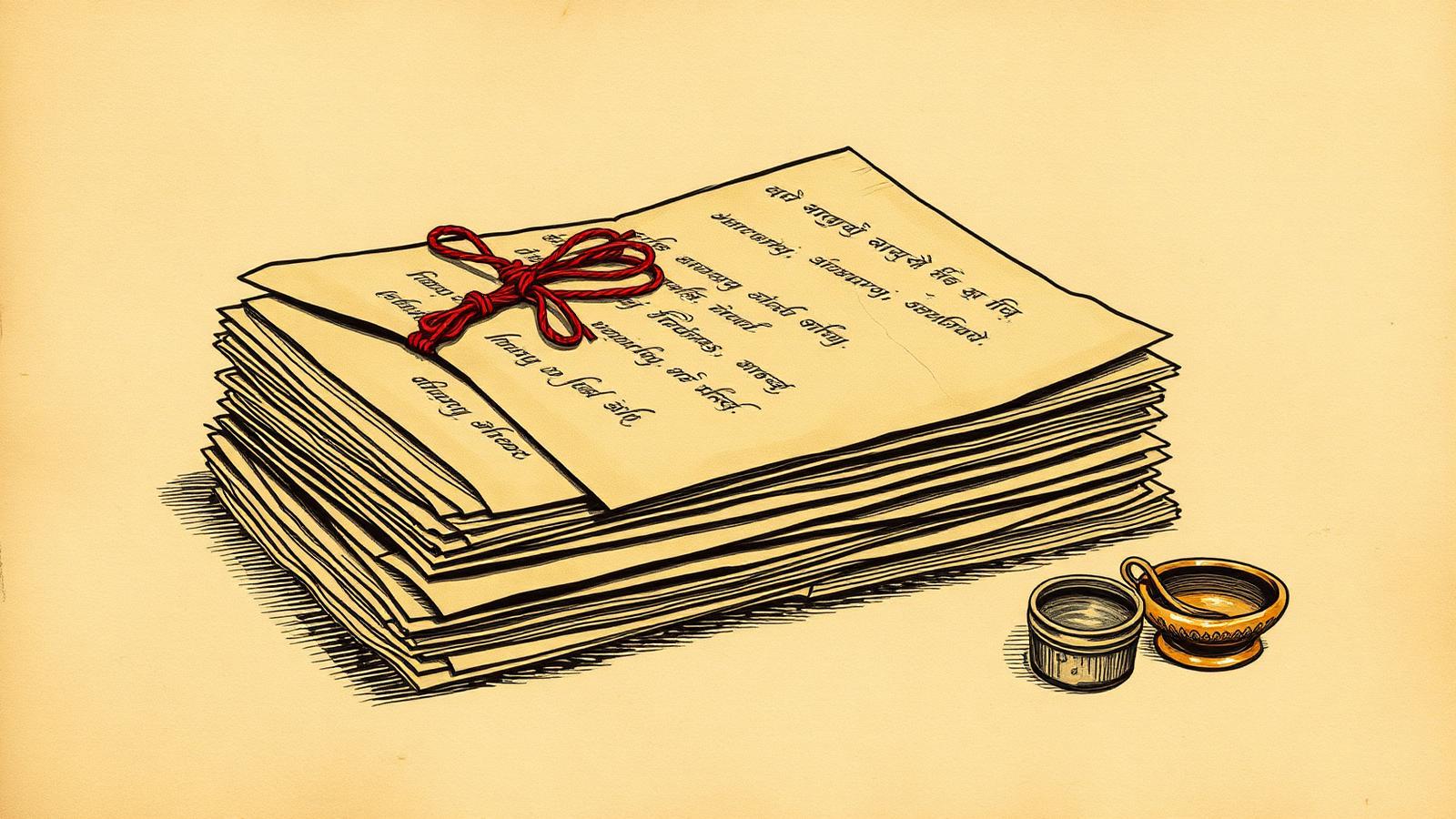
The nadi tradition traces itself to a group of Tamil Siddha sages who are said to have written the life stories of every person who would ever live onto palm leaves thousands of years ago. Historical scholarship is less certain about the exact age. What is not in doubt is that palm leaf libraries in Tamil Nadu exist, that some of the manuscripts are genuinely old, and that the reading practice is documented at least back to the medieval period.
The best-known centre is Vaitheeswaran Koil, a temple town near Chidambaram in Tamil Nadu. Readers there work in family lineages, often passing the practice down over several generations. There are also branches in Kerala and among the Tamil diaspora in Singapore, Malaysia, and Sri Lanka.
How a reading actually works
You arrive and the reader takes your thumbprint. Right thumb for men, left thumb for women, in the traditional practice. Your print is matched against a set of categories the manuscripts are indexed by. The reader then brings out a bundle of leaves that could match, and starts working through them.
The reading is a back and forth. The reader reads a line off the leaf ("your father's name begins with the letter M"), you confirm or deny, and they either move on to the next leaf or continue down the current one. If a leaf matches through several confirmations, that leaf is treated as yours and the reader reads it out in full: your name, your parents' names, your marital status, and predictions for the rest of your life.
What the reading covers
A full nadi reading is usually broken into chapters. The general chapter covers your life overview. Other chapters cover marriage, career, health, and past-life karma. Each chapter is a separate reading, often paid for separately. A full set can take a full day.
The honest question about accuracy
Nadi readings range from uncannily specific to disappointingly generic. Some people walk out of Vaitheeswaran Koil having heard their own name and their parents' names read off a manuscript they had never seen before. Others get a reading that could apply to anyone.
The critical view is that thumbprint categories are broad enough that skilled readers can use conversational cues to narrow the answer, the way a good cold reader does. The traditional view is that the leaves were written for the specific people who would come to read them, and the match is real. Both positions have defenders. The honest answer is that anyone claiming certainty on this question is oversimplifying it.
How nadi fits with Indian palmistry
Nadi astrology and Indian palmistry are cousins inside the same broader Vedic astrological tradition, but they are separate skills. Nadi is manuscript-based and biographical. Indian palmistry reads the hand and character. A traditional Indian reader will often be trained in Vedic astrology first, and may practice palmistry or nadi reading as a second skill.
For the palmistry side of the tradition, the Indian and Vedic palmistry article is the one to read. For the wider palm reading map, the palm reading guide is the hub.
Frequently asked questions
- What is palm leaf reading?
- Palm leaf reading, also called nadi astrology, is a South Indian divination tradition where a reader identifies a manuscript written on dried palm leaves that is said to describe your life. It is not palmistry. Nothing about your hand is read. The palm in the name refers to the palm tree leaves the manuscripts are written on.
- How does nadi astrology work?
- You give the reader your thumbprint. They match it against a library of palm leaf manuscripts that are said to have been written by ancient rishis (sages) thousands of years ago. If they find a leaf that matches, they read it out loud, and it is supposed to contain your name, your parents' names, and the events of your life.
- Where is nadi reading practiced?
- The main centres are in Tamil Nadu, especially Vaitheeswaran Koil near Chidambaram, and there are branches in Kerala and among the Tamil diaspora in Singapore, Malaysia, and Sri Lanka. The tradition is closely tied to the Tamil Siddha lineage.
- Is palm leaf reading the same as palmistry?
- No. Palmistry reads the lines on your hand. Palm leaf reading reads ancient manuscripts on palm tree leaves. The two get confused in English because both use the word palm. In Tamil and other Indian languages the words are completely different: kai rekai for palmistry, nadi jyothidam for palm leaf reading.
- Is nadi astrology real?
- The manuscripts are real. Palm leaf libraries in Tamil Nadu are documented and some leaves are centuries old. Whether any given reading matches your actual life is the point people debate. Some readings come out uncannily specific. Others come out generic. Approach it with an open mind and the same critical eye you would bring to any divination.
Keep reading
- Indian & Vedic Palmistry (Hast Rekha): A Complete Introduction
Hast rekha in English: the Indian and Vedic tradition, the mounts as planets, and how it reads a hand.
- Palm Reading: The Complete Guide to Palmistry
The full palmistry guide: every line, every mount, every hand shape in one place.
- Palmistry Mounts: The 8 Mounts of the Hand & Their Meanings
Venus, Jupiter, Saturn, Apollo, Mercury, Luna, and the two Mars mounts, without the mystical fog.
- Online Palm Reading
Get your palm read online in minutes.